
Respect
The approach respects each child as a unique individual—different from adults and from other children. Understanding differences and accepting one another with love and respect is the key to fostering creativity.
Pick the monthly plan that fits. Your website build is included — we'll take it from there.
We run your website for you.
We run your front desk for you.
We run your front office for you.
You'll be taken to secure card checkout (Stripe) for your monthly plan — your website build is included. Texting switches on once the carriers approve your registration, usually 1–2 weeks. See everything in each plan →
Online checkout isn't available right now, so we'll reach out shortly with your secure payment link and launch timeline.
Your full site build is underway. Watch your email for your owner-portal invite and launch timeline — we'll take it from here.
“The first thing to be done therefore, is to discover the true nature of a child, and then assist him in his normal development.” — Maria Montessori, The Secret of Childhood
Dr. Maria Montessori became a forerunner of the progressive movement in education. Her ideas about child rearing and early learning grew from her experience and observation of children with different capabilities, from all walks of life. Her experiments were built on the two principal ideas of the education of the senses and the education of movement. She adapted and developed them into a systematic method that served her life’s work: the discovery of the child.
To understand the essence of the Montessori method, a little introduction to her view of child psychology and development is helpful. Montessori recognized certain characteristics common to all children, regardless of background. Childhood moves through successive phases of growth, she said, and each phase carries its own sensitivities that move physical and mental development forward.
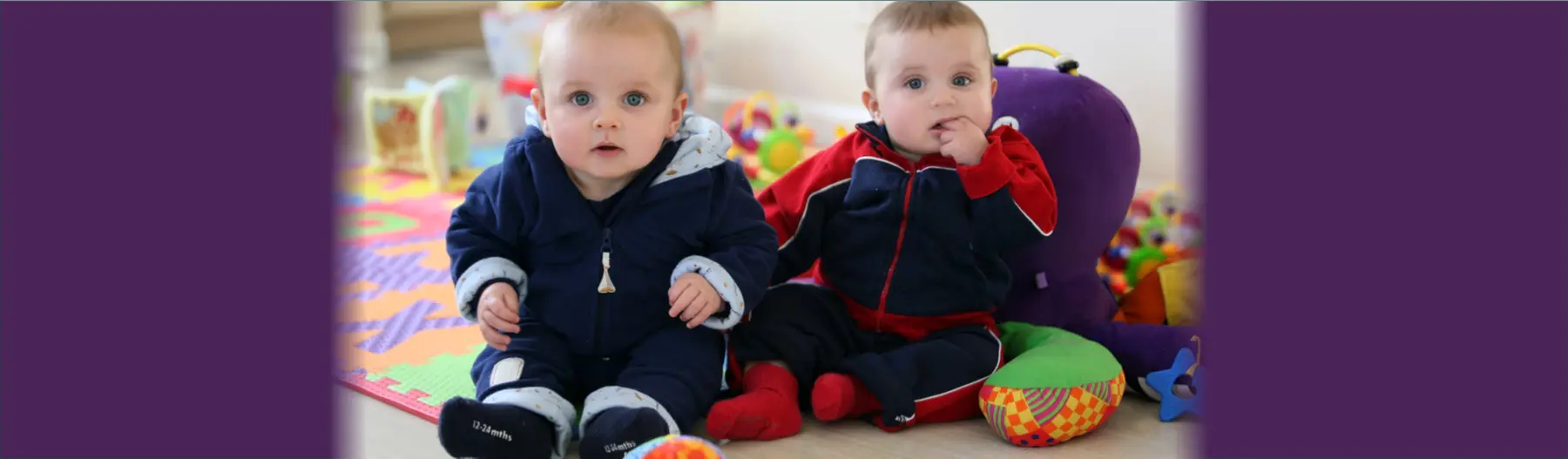
Montessori called these phases “sensitive periods.” During a sensitive period, a child shows intense interest in particular sensorial and abstract experiences. These sensitivities move a child toward learning; they are needs that demand fulfillment. Children have inborn drives and energies that predispose them to develop new knowledge and skills, time after time. They explore with their hands, taste, sight, and sound. Once a child has gained enough knowledge of the environment or activity that fascinated them, the phase passes, the uncontrollable urge fades, and the child enters the next sensitive period. Montessori identified six such sensitive periods: sensitivity to order, sensitivity to language, sensitivity to walking, sensitivity to the social aspects of life, sensitivity to small objects, and sensitivity to learning through the senses. Each of these is expanded upon at our parent information nights.
The approach respects each child as a unique individual—different from adults and from other children. Understanding differences and accepting one another with love and respect is the key to fostering creativity.

An environment can either foster creativity or restrict it. The Montessori prepared environment is designed to meet the child’s needs during learning and development, so the child can develop naturally through spontaneous, effortless, self-directed activity.

The young child has an absorbent mind that unconsciously soaks up information from the environment at a rapid rate. This learning process is unique to early childhood and lasts through the first six years of life. The Montessori method is designed to take advantage of these mental powers during those critical years.
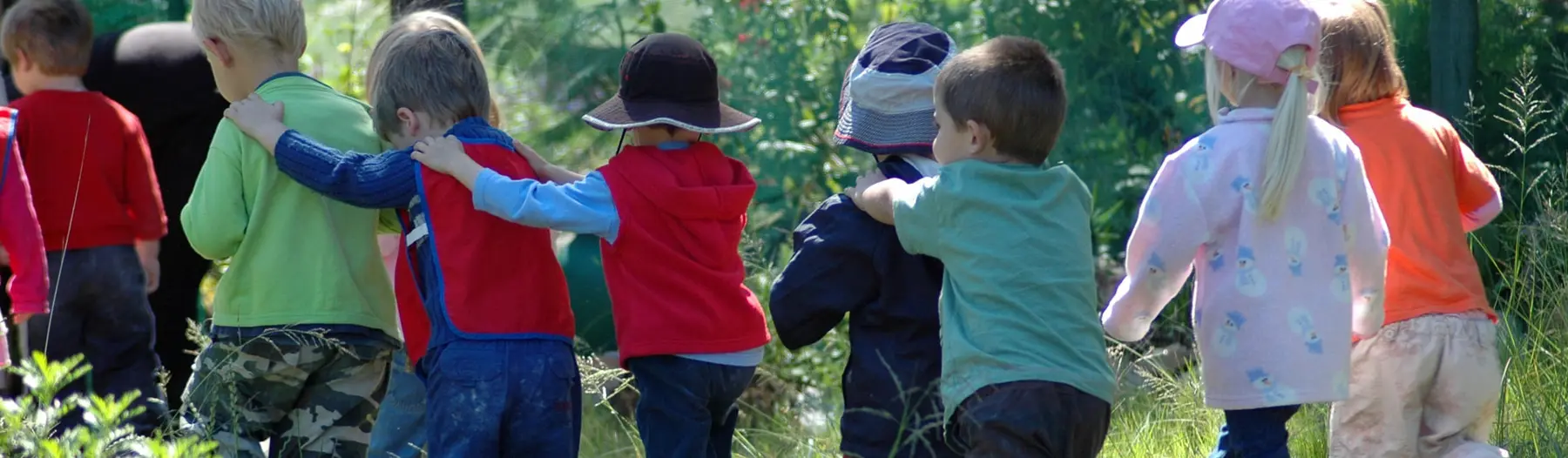
Sensitive periods mark the critical stages of development when a child can learn a particular skill far more easily—times of intense fascination with language, order, movement, or another area of growth.
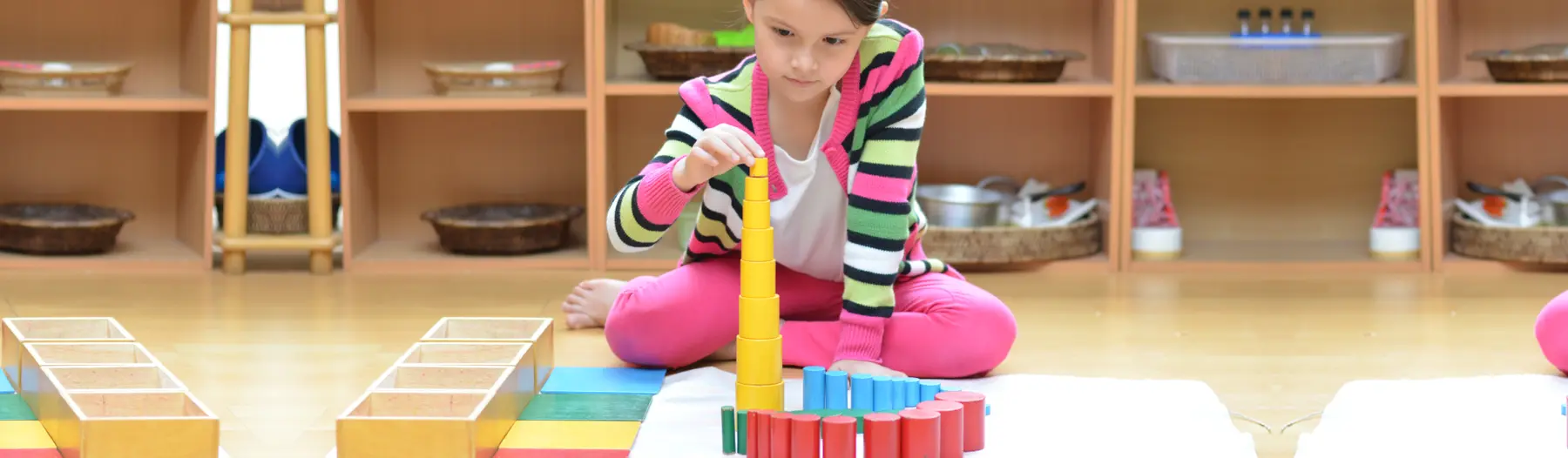
A Montessori child is free to move, choose work, and follow what interests him most, while the environment provides a careful balance of freedom and structure. Materials are returned to their proper places, individual work is respected, and a child may work alone without interruption. This blend builds independence, self-reliance, and genuine fulfillment.
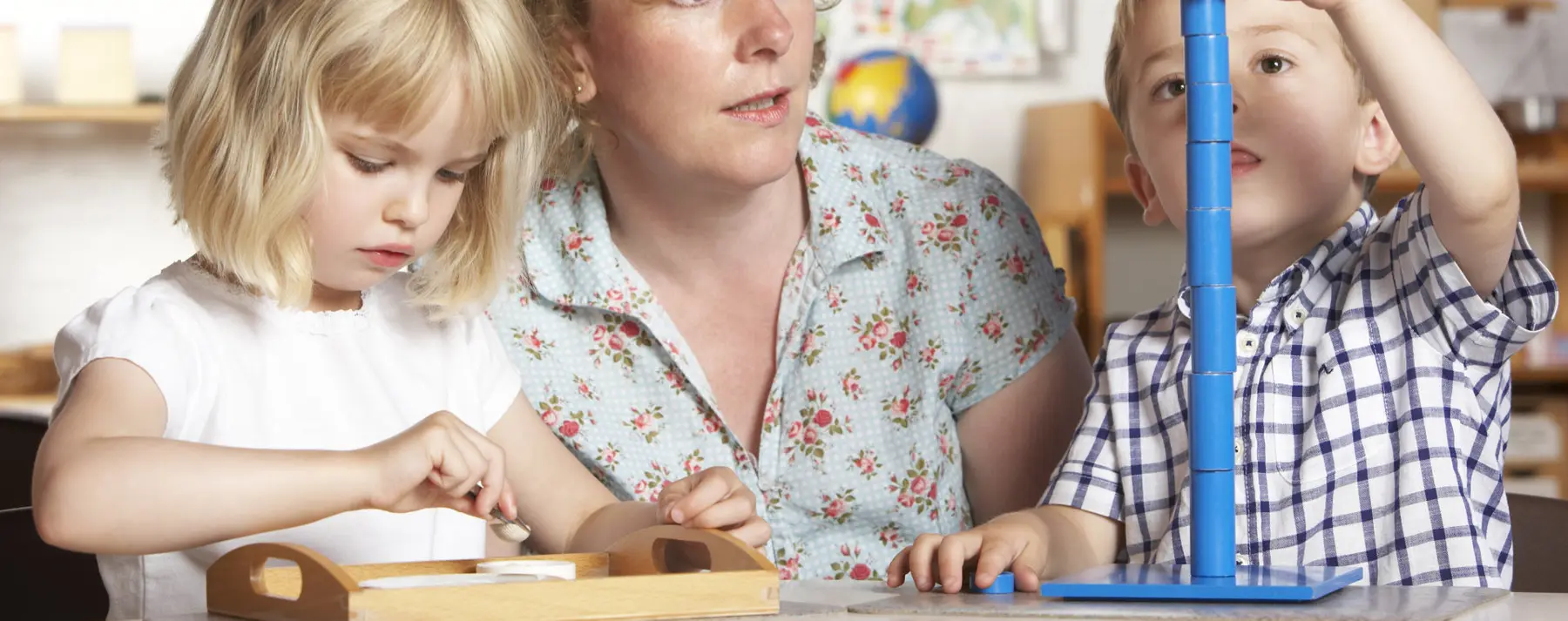
The directress guides each child through developmentally appropriate activities rather than lecturing the group. Presentations are brief and efficient—enough to intrigue, not exhaust. She observes each child’s specific interests and keeps an accurate record of strengths, accomplishments, and work.
Maria Montessori was born in Ancona, Italy, in 1870. In 1896, she became the first woman in Italy to earn a Doctor of Medicine degree. Despite many obstacles, she became well known for her expertise in psychology, philosophy, anthropology, and medicine. As a physician, her first educational encounter with children took place in a psychiatric clinic in Rome, where the children were labeled “mentally retarded.” There she realized the potential and capabilities of these children. Through careful observation and experiment, she concluded that all children have an inborn motivation to learn—an innate desire fulfilled through their senses. In fact, she believed, a child cannot be stopped from doing so.
Montessori first put her ideas to the test when she was asked to head a preschool for sixty underprivileged children in the slum section of San Lorenzo, Italy. She called it “The Children’s House,” or Casa dei Bambini. Her method was based on the scientific observation of children’s natural learning abilities and progressions. The room was prepared for the children, with child-sized furniture and a range of developmentally appropriate materials from which they could choose freely. The children, all under six and from poor socioeconomic backgrounds, showed rapid development within six months. They preferred her educational materials to toys, learned to be orderly, and gained self-esteem in their newfound independence. They became self-reliant, worked with concentration and joy, and cared for their environment. Montessori envisioned a community of parents, teachers, and children working together toward personal growth and empowerment. Montessori teaching today still stands for a first-class education around the world, and much of what she recorded in The Discovery of the Child is now supported by modern research, including the work of Piaget, Gardner, and Coleman.

Montessori discovered that children develop social and mental strengths when they work together at different levels of ability. The three-year age span of a Montessori classroom offers diversity and stimulation, and because the group stays together longer, children form true friendships. Older children gain maturity and confidence as younger children look up to them as role models and leaders. Younger children observe and imitate older peers, while older children reinforce their own learning by teaching a skill to someone younger. This give-and-take relationship builds mutual help, respect for one another’s feelings, and easy cooperation across ages. Montessori wanted children to feel that their school is like a second family. Multi-age grouping also lets a teacher work with the same child for two or three years, getting to know that child’s learning style and temperament very well. That time and knowledge give the teacher what she needs to support early learning in every child.

This comparison, adapted from the American Montessori Society, shows that Montessori education is child-centered while conventional education is teacher-centered. The two lists—MONTESSORI and CONVENTIONAL—sit side by side so the everyday differences are easy to see. In a Montessori classroom, learning engages all five senses rather than relying on listening, watching, memorizing, or reading. Children learn at their own pace according to what interests them, choose from many possibilities, and move freely. Learning is a process of discovery that leads to concentration, motivation, self-discipline, and a love of learning.
No. Each child in a Montessori classroom develops and advances in their own time, at their own individual pace. That principle is central to the method. If Montessori children seem more advanced than traditional expectations for their age, it is not because of pressured teaching or competition. It reflects the vast possibilities and potential children carry within them when they are allowed to learn at their own pace, pursue what interests them during their sensitive periods, and work in a specially prepared environment. The goal is to initiate logical thought and discovery internally. Dr. Montessori designed the materials to draw the child’s attention to size, shape, color, texture, weight, smell, sound, taste, and dimension—all through sensory integration.
Montessori is a philosophy of education that follows the whole child through every successive phase of development, from birth through adolescence and puberty. Besides the customary preschool program for ages 3-6, you may find elementary, junior high, and high school programs, as well as a growing number of infant and toddler programs. The multi-age age groups begin with preschool ages 3-6, followed by elementary ages 6-9 and 9-12, and middle or junior high school ages 12-15.
Learning in a Montessori classroom is individual. Each child progresses at their own rate according to their own interests, and the test of progress is the child’s own development rather than comparison with peers. There are no rewards or punishments attached to another child’s achievement, so the classroom stays a place of cooperation, not competition.
Because the method had succeeded with children experiencing learning deficiencies, Maria Montessori was eager to see how normal children would respond to her materials. She had that opportunity with children ages 3 to 7 when she was asked to direct a day care center in the poor San Lorenzo section of Italy. Her methods produced startling progress. Montessori had reasonable proof that her method did not discriminate. The classroom accommodated a wide range of students from all socioeconomic levels—average and above average, learning disabled, and physically handicapped. The approach has been used successfully with children from two months to eighteen years of age. A gifted child can dive into more complex materials, while a child who is progressing more slowly can explore at their own level of understanding and pace.
No. The Montessori curriculum centers on five focus areas: practical life, sensorial, math, language arts, and cultural subjects. The philosophy itself is not religious, though the spiritual inner self and the whole child are respected and recognized. Many Montessori schools teach about different religions from a cultural and educational perspective, integrating world cultural subjects and religion. Montessori education values diversity and does not discriminate. The Montessori School of Hamilton has no religious orientation and honors and respects every religion.
There are more than 500 self-correcting, sensorial manipulative materials, and each one isolates a different concept. Children find an inviting array of colored beads, puzzle maps with knobs, solid geometric forms, rods and blocks, cylinders and cubes, color tablets, and sound boxes—materials that let them discover size, shape, color, texture, sound, weight, smell, taste, and dimension through their senses. The control of error is built into the materials, so the child can recognize a mistake and correct it without the teacher. This supports independent problem solving. The concrete apparatus moves the child from concrete concepts toward abstract understanding. With each material mastered, a child becomes increasingly self-confident and self-reliant, while gaining the knowledge and skills needed to carry out their own choices.
Preparing the environment is one of the teacher’s primary tasks. Children are introduced to materials and lessons in all subject areas, according to individual development. In a brief but interesting presentation, the teacher shows the child the proper way to handle and use the material, where it belongs, and how to put it away in an orderly manner. Once a material has been properly presented, the child is free to engage with it. Materials are reintroduced at increasing levels of complexity, and all interest centers can be explored at any time of day and at every level of development.
Children are allowed to make individual choices, and their decisions are expected to be responsible judgments. This measure of independence gives the child the opportunity to carry responsibility, and that responsibility forms the basis for self-discipline. Mastery of each task brings self-confidence and self-reliance—and the rewarding satisfaction that comes from real accomplishment and a newly learned skill. Children also learn to appreciate the freedom and respect they are given, and so they become considerate, mature little people who carry a lifelong love of learning.
Montessori establishes habits of concentration, perseverance, and thoroughness in the early years. Those habits produce a competent, confident learner in later years. With these qualities, a Montessori child eases into mainstream classrooms and adapts easily and quickly to the new routine. The method also blends naturally with public education, where diverse groups of children from many backgrounds learn together.
Research studies indicate that Montessori children are well prepared for later life academically, socially, and emotionally. Along with scoring well on standardized tests, Montessori children tend to rank above average on following directions, turning in work on time, listening attentively, using basic skills, showing responsibility, asking provocative questions, showing enthusiasm for learning, and adapting to new situations.

See how a carefully prepared environment guides self-directed learning and discovery.