

Montessori Curriculum
See how the classroom’s interest centers connect to the full Montessori curriculum and daily learning experiences.
Pick the monthly plan that fits. Your website build is included — we'll take it from there.
We run your website for you.
We run your front desk for you.
We run your front office for you.
You'll be taken to secure card checkout (Stripe) for your monthly plan — your website build is included. Texting switches on once the carriers approve your registration, usually 1–2 weeks. See everything in each plan →
Online checkout isn't available right now, so we'll reach out shortly with your secure payment link and launch timeline.
Your full site build is underway. Watch your email for your owner-portal invite and launch timeline — we'll take it from here.
Our peaceful classroom begins with Maria Montessori’s belief that “the child should live in an environment of beauty.” The atmosphere is calm, orderly, and deliberately simple, inviting children into deep concentration.
Each classroom has adjustable recessed lighting and separate temperature zones so that light and warmth can meet the needs of the children inside. Storage space keeps materials organized, while both carpeted floor areas and wet space give children room to spread out, wash their hands, and clean up on their own. The wet space is usually about 300 square feet, with room for lunch. Every classroom has its own entrance and exit that opens onto an individual outdoor space.
The layout begins the Montessori process of independence. Because the environment lets children care for their own needs and help themselves, they gradually become more independent of the teacher. In every room, the classroom contains an abundance of concrete, manipulative materials maintained in an orderly, clean, and attractive way. The materials reflect reality and nature, helping children accurately organize their perception of the world. And because the materials are readily accessible on low shelves and display tables, children are free to choose according to their own interests.

Each classroom opens out onto a safe and protected outdoor space designed for vigorous motor activity and the discovery of nature. The school sits on over two acres of beautiful grounds, combining protected natural habitat, open free-play space, and gardening and planting areas for each class. Benches give waiting children a comfortable spot, child-sized picnic tables are scattered around, and our safe playgrounds keep climbing, running, and active play close by. The whole outdoor setting feels like a beautiful park — one more part of the prepared environment where children can move, explore, and breathe.
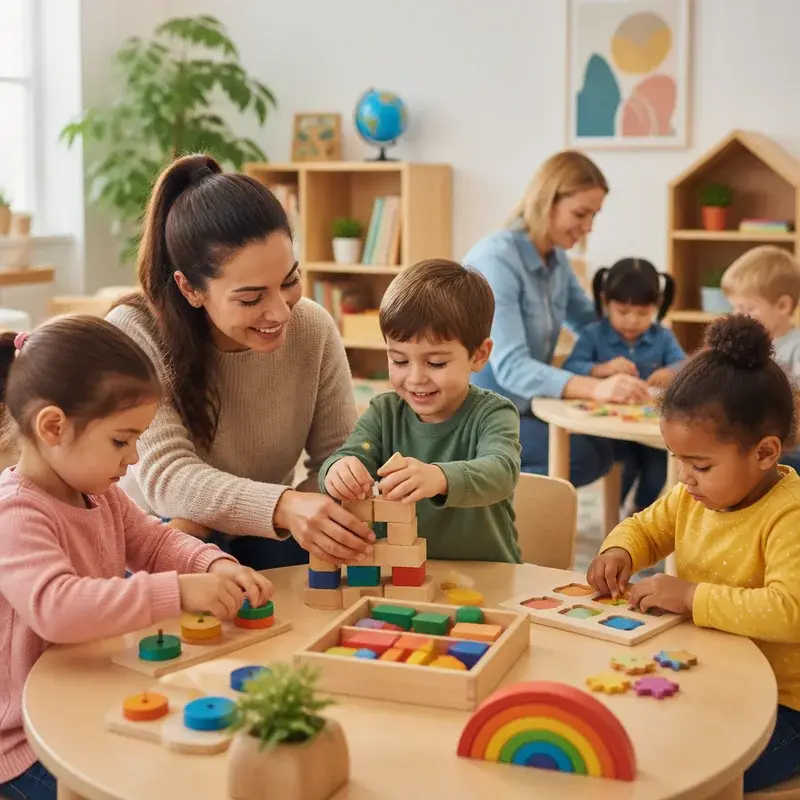
The classroom is filled with specially designed materials that stimulate your child into meaningful, purposeful activity. As children manipulate the apparatus, they learn to differentiate, compare, discriminate, and explore — all through their own senses. These exercises provide stimuli that trigger intense concentration and attention, and children tend to engage with their work with passion and ingenuity, more so than if the work were simply assigned. An excerpt from Montessori — A Modern Approach by Paul Polk Lillard best describes the principle behind the materials: “They are not learning material in the conventional sense, because their aim is not the external one of teaching children skills or imparting knowledge through “correct usage.” Rather, the aim is an internal one of assisting the child’s self-construction and mental development. They aid this growth by providing the child with stimuli that capture his attention and initiate a process of concentration.”
Dr. Montessori scientifically designed each material to draw a child’s attention to the sensory properties of the physical world — size, shape, color, texture, weight, smell, sound, taste, and dimension — through sensory integration. As children work, they begin to notice intricate details in the environment and gradually move from simple, concrete recognition to more complex, abstract concepts, led by their own interests.
One exceptional feature of the equipment is the built-in control of error. A child can recognize a mistake visually and correct it without waiting for an adult to point it out, keeping them on the right path to progress. The materials also prepare children indirectly for future skills. The knobs and handles they grip with finger and thumb strengthen the coordination needed to use a pencil. Tracing sandpaper letters with their fingers activates muscular memory in the correct formation of each letter, so when the time comes to write, the child does so with less effort and frustration. True to Montessori’s child-sized philosophy, all of the materials are placed on low shelves and display tables where every child can reach them easily. The wide variety of materials is arranged into interest centers throughout the room and classified into organized curriculum areas: language arts, math and geometry, practical living, sensory awareness activities, puzzles, geography, history, science, art, music, and movement. Within each center, materials are arranged in a special sequence from the upper-left-hand corner to the lower right, gradually increasing in complexity — from the simplest and most concrete to the most complex and abstract. The result is a series of little learning centers where a child can select, manipulate, absorb, and learn, all in a warm and caring environment, and all while having fun.

See how the classroom’s interest centers connect to the full Montessori curriculum and daily learning experiences.

Go deeper into the lighting, layout, materials, and outdoor design that support focus and independence.
Browse the gallery at your own pace, then come see the prepared environment in person.

Why this child-led, prepared approach matters for your child’s confidence and love of learning.