

The Montessori Method
Understand the philosophy and principles behind every classroom experience.
Pick the monthly plan that fits. Your website build is included — we'll take it from there.
We run your website for you.
We run your front desk for you.
We run your front office for you.
You'll be taken to secure card checkout (Stripe) for your monthly plan — your website build is included. Texting switches on once the carriers approve your registration, usually 1–2 weeks. See everything in each plan →
Online checkout isn't available right now, so we'll reach out shortly with your secure payment link and launch timeline.
Your full site build is underway. Watch your email for your owner-portal invite and launch timeline — we'll take it from here.
We see curriculum as much more than basic skills, pre-reading, or writing. Maria Montessori wrote, “The child can only develop by means of experience in his environment. We call such experience work.” Our classrooms put that principle into practice. Voilà! A confident, enthusiastic, self-directed child is the result.
We also believe learning and fun go hand in hand, so the Montessori curriculum does not pause when summer arrives. Our Summer Fun program keeps morning and afternoon work periods going, reinforcing skills and knowledge so they are never forgotten. We never split the day into “child care time” and “Montessori time”; all children benefit from the Montessori method all year round — summer and winter, child care and preschool, and the approach reaches beyond school into the home and family.
The curriculum itself is composed of interrelated themes, a spiral of integrated studies that complement one another. Children begin with the most concrete ideas and gradually move toward the more complex and abstract, revisiting each theme in deeper ways as they develop. Over time, an intricate web of knowledge forms and become the foundation for a continuum of learning.
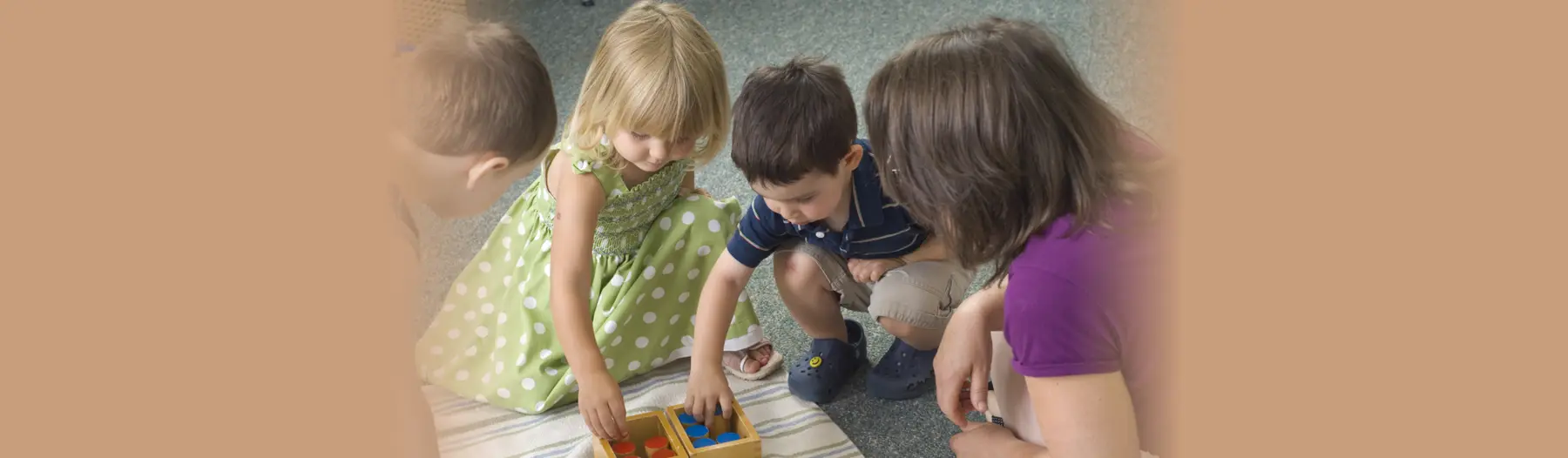
Montessori education has often been described as a flow experience. A child proceeds with ease, building the inner self through continuing self-construction. Each prepared classroom offers an uninterrupted series of learning passages that form a continuum across the full three-year cycle. Children have the freedom to move and the time they need to finish what they have started, without interruptions. Activities evolve in complexity and challenge as children do. Early reading is a perfect example. In the Montessori classroom, children enter the language arts long before they actually read. There is no rigid directive teaching plan. Instead, teachers guide each child through integrated, tactile learning concepts that prepare them to read as naturally as they learned to speak. As early as age three, children work on beginnings, middles, and endings; sort and match from left to right; hear phonetic sounds; feel and trace sandpaper letters; and use the moveable alphabet. The environment is logical and sequential, which gives structure to their discovery. Math and shapes are discovered, not presented; spelling rules are derived by recognizing patterns, not by memorizing. Every aspect of the curriculum involves both creative invention and thoughtful analysis. We believe how and why a child arrives at knowledge matters as much as the knowledge itself — and there is even more happening in our classrooms than that.
From birth, a child’s greatest work is becoming the adult they are meant to be. The transformation from infant to toddler to preschooler is extraordinary, and we are privileged to witness it every day alongside families. Montessori teaches us to follow the child, assisting natural growth and gently guiding each milestone rather than forcing it.
Every classroom at our school is designed for the developmental needs of the children in it, and each room tells its own story — from the silent observer in the infant room to the cruising crawler to the stomping, romping toddler. A child’s happiness in these early years depends on basic needs such as water, food, shelter, and freedom. That happiness is natural and universal, and it yearns to be cultivated and kept alive through every stage of development. Protecting it is just as fundamental to healthy growth as protecting curiosity.

We invite you to visit and observe quietly, the same way the infants observe. Watch how the toddlers grasp concrete meaning, and see primary preschoolers expanding their minds as their independence grows. Every classroom is a window into this process in action. When people ask what children take with them long after Montessori, the answer goes well beyond academic skills. They carry a lifetime of good work habits, life tools, and a deeper sense of their own place in the world. Dr. Montessori believed the most important goals in life are to find meaningful, fulfilling work and to cultivate inner peace and depth of soul — qualities that allow us to truly love.
Sensorial exercises help children discriminate, refine, and sharpen their senses — size, shape, weight, color, sound, and more. Practical life activities like sweeping, dusting, pouring, folding, polishing, and cooking build daily-life mastery and refine motor control.
Math begins concretely with quantities 1–10 and progressively expands to 1–1000. Symbols follow through manipulative materials, and basic operations are introduced afterward.
Phonetic preparation starts with sandpaper letters. Word building and preliminary reading follow naturally as each child shows readiness, while print and cursive letters, penmanship, and creative writing are practiced along the way.
Through cultural work, children are introduced to the world and its living things, with studies in history, geography, and science.
Music is part of the expressive life of the Montessori classroom, offering another avenue for joyful discovery.
In the Casa, art is presented by the classroom teachers, who guide children in exploring the world of art.
Physical fitness is valued here, with opportunities for creative movement through dance, drama, and sports. In the Casa, the class directress weaves physical education into her weekly routine.
Understand the philosophy and principles behind every classroom experience.
See how the prepared environment supports concentration, independence, and natural development.

Discover the tactile, hands-on materials that make abstract ideas concrete — from sandpaper letters to the moveable alphabet and more.
Visit our classrooms and see the Montessori curriculum come alive in every child’s work.
Schedule a classroom visit